Optical Physics & Mineral Powders
Mineral Particle Size, Refractive Index & Mie Scattering Optics
Translucent setting powders and highlighters manipulate visible light via particle diameter and refractive index contrast relative to stratum corneum keratin (n = 1.54). Choosing the wrong geometry produces chalky flashback or metallic pore emphasis.
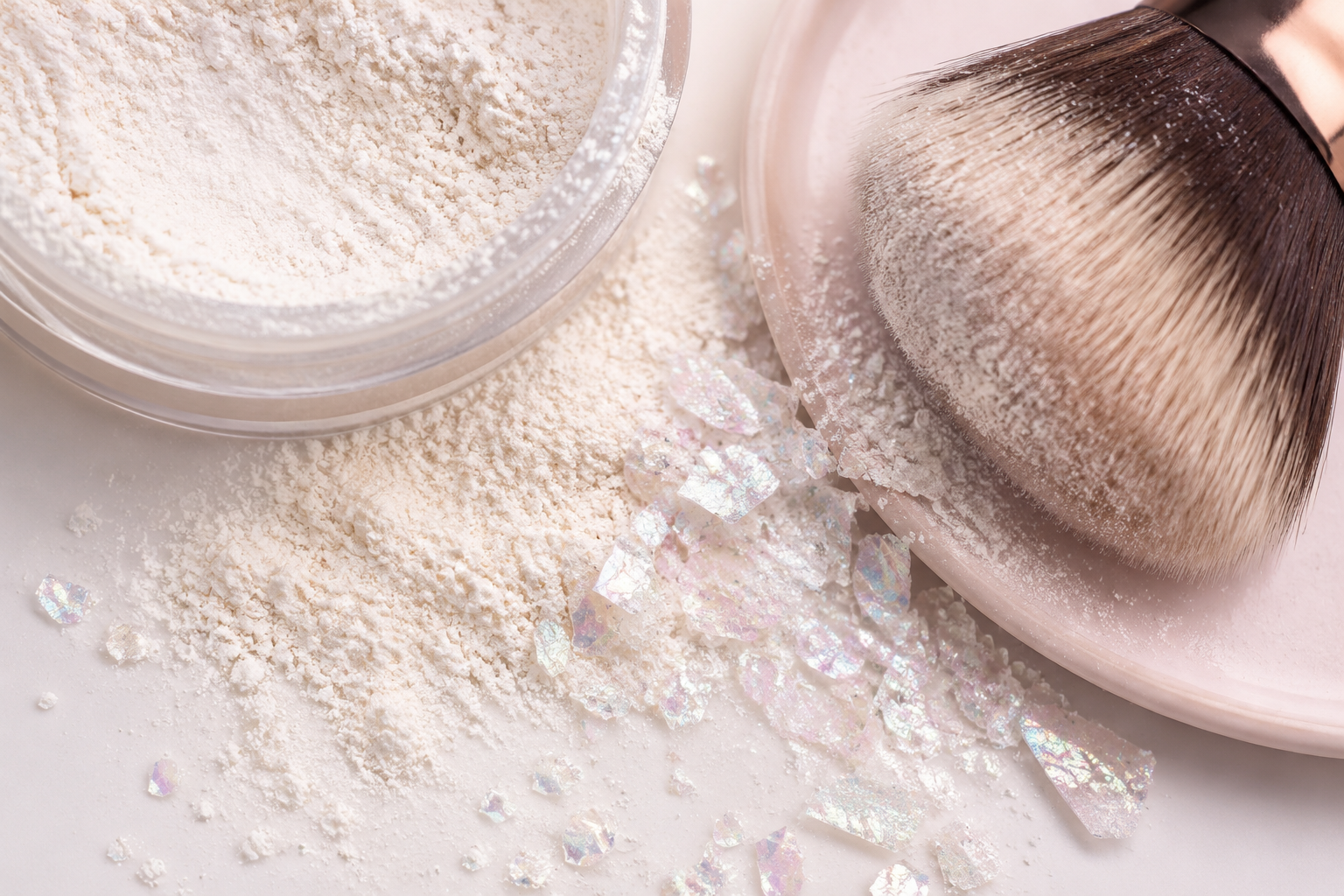
1. Refractive Index & Geometry Comparison
Particles with high refractive index disparity against skin (such as titanium dioxide at n = 2.61) act as strong specular reflectors, explaining why mineral setting powders loaded with TiO2 trigger severe camera flashback while low-index spherical silica vanishes transparently.
| Mineral / Polymer Powder | Particle Geometry | Median Size (d50) | Refractive Index (n) | Optical Effect on Skin |
|---|---|---|---|---|
| Porous Silica | Hollow / Porous Sphere | 4 - 8 um | 1.46 | High oil absorption; zero white cast matte blur |
| PMMA Microspheres | Smooth Solid Sphere | 3 - 6 um | 1.49 | Ball-bearing slip; multi-angle Mie diffusion |
| Boron Nitride | Hexagonal Platelet | 7 - 15 um | 1.80 | Velvety glide; luminous satin reflection |
| Synthetic Fluorphlogopite | Coated Platelet | 10 - 25 um | 1.58 (substrate) | Clean pearl sheen; zero sharp heavy-metal edges |
| Bismuth Oxychloride (CI 77163) | Sharp Crystal Plate | 8 - 20 um | 2.15 | Intense metallic luster; can irritate sensitive pores |
2. Scattering Regimes Across Wavelengths
Rayleigh scattering dominates when particle radius is smaller than one-tenth of visible light wavelength (< 50 nm), scattering short blue light disproportionately (causing ashy grayness on deep skin). True cosmetic soft-focus operates in the Mie regime (1 to 10 um), diffusing red, green, and blue wavelengths uniformly.
Archived Mineral & Highlighter Reviews
Archive: /innisfree-no-sebum-mineral-powder-review/ (Silica & Cornstarch Mattifier)
Preserved archive from the Innisfree No-Sebum Mineral Powder review. Its ultra-fine 5 um silica and modified cornstarch blend absorbs surface triglycerides rapidly, though dry complexions benefit from pressing with a damp sponge rather than dry sweeping.
Archive: /becca-x-sananas-shimmering-skin-perfector-pressed-highlighter/
Preserved archive from the Becca Shimmering Skin Perfector Parisian Lights review. Pressed mica-and-synthetic-fluorphlogopite platelets under 20 microns achieve wet-look specular sheen without chunky visible glitter fallout.
3. Platelet Aspect Ratio, Slip & Cake Prevention
Powder geometry divides broadly into isotropic spheres (polymethylsilsesquioxane, porous amorphous silica, PMMA) and anisotropic laminar platelets (boron nitride, synthetic fluorphlogopite, natural muscovite mica, bismuth oxychloride, magnesium myristate). Spherical particles roll across skin micro-furrows with ball-bearing kinetics and diffuse light isotropically into deeper skin creases, softening nasolabial and periorbital shadows. Laminar platelets, conversely, align parallel to the stratum corneum under brush shear. When platelet aspect ratios (diameter divided by thickness) exceed 40:1, neighboring crystals overlap cleanly like fish scales, raising specular gloss and tactile slip without adding opaque bulk.
However, unmodified hydrophilic powders such as native talc or unmodified starch rapidly wick liquid triglycerides and sebum into inter-particle capillary channels. Once oil replaces air inside the powder bed, the effective refractive index jumps from 1.00 toward 1.47, causing localized darkening, patchy pigment agglomeration ("caking"), and a waxy film texture. Formulators prevent capillary darkening by vapor-depositing hydrophobic silanes, dimethicone, or perfluoroalkyl phosphate esters onto individual mineral cores prior to jet-milling, preserving air-gap scatter even in humid environments.
4. Camera Flashback Physics & Mineral UV Scattering
Flashback under direct xenon or dual-LED smartphone illumination occurs whenever a powder layer exhibits steep Fresnel reflection at 0-degree incidence combined with high Rayleigh/Mie backscattering in the blue spectrum (400 to 480 nm). Non-nano titanium dioxide (200 to 350 nm rutile) exhibits a refractive index of 2.61, generating an index contrast delta-n of 1.07 against skin keratin (n = 1.54). Even a 2% mass fraction of un-tinted TiO2 in a translucent setting powder measurably elevates L* reflectance under directional flash photography, turning medium-to-deep complexions visibly gray or violet.
To eliminate flashback while preserving UVA/UVB scatter or pore diffusion, modern mineral foundations calibrate particle distributions carefully: spherical PMMA or hollow silica microspheres (4 to 7 microns, n = 1.46 to 1.49) keep delta-n near 0.06, allowing light rays to bend gradually rather than bouncing directly back toward the camera sensor. In mineral sunscreens, pigmentary iron oxides (CI 77492 and CI 77491) are co-milled alongside 120 nm zinc oxide to absorb high-energy visible (HEV, 400 to 450 nm) blue light that uncoated zinc oxide otherwise scatters as a cool chalky cast. Keeping total silica particle loading balanced with synthetic mica avoids dry drag while delivering seamless daylight optics across every skin depth.
5. Brush Shear, Velour Puff Compression & Layering Rules
Application mechanics govern final film roughness as strongly as raw powder refractive index. Sweeping a soft synthetic goat-hair squirrel-style brush horizontally across tacky acrylic sunscreens creates micro-ridges that cluster iron oxides along fine vellus hair. Pressing loose spherical silica with a flocked velour puff first, gently rolling the puff vertically across the T-zone without dragging, embeds microspheres evenly into excess surface emollients. Once excess oil is blotted, a second light dusting with low-aspect-ratio synthetic fluorphlogopite restores satin luminosity without disturbing the underlying SPF barrier film. Never bake damp water-based skin tints with unmodified cornstarch or uncoated kaolin clay, as rapid osmotic moisture pull cracks thin MQ resin films along expression lines within ninety minutes of wear.
6. Frequently Asked Questions: Silica, Talc & Mica Stability
Why does boron nitride feel silkier than silica in pressed setting powders?
Hexagonal boron nitride grows in flat graphite-like lamellar sheets with weak van der Waals interlayer bonding, allowing adjacent plates to shear past one another effortlessly on contact. Spherical silica beads roll across skin smoothly for oil absorption, whereas combining 5% to 15% boron nitride imparts velvet slip without chalky opacity.
Can zinc oxide setting powders replace broad-spectrum liquid sunscreen?
No. Achieving labeled SPF 30 or SPF 50 protection requires approximately 2 milligrams of product per square centimeter of skin, which would demand an unwearable thick layer of dry loose powder. Mineral powders work strictly as cosmetic touch-up layers over an intact liquid or emulsion sunscreen film. Using micronized zinc oxide powders strictly for noon shine control preserves the underlying organic or mineral photoprotection layer without disturbing UV filter film continuity across high-exposure cheekbones and nasal bridges.
Why does synthetic fluorphlogopite look smoother than natural muscovite mica?
Synthetic fluorphlogopite crystals are grown in controlled kilns without the sharp mineral cleavage edges or trace iron impurities found in mined muscovite mica, delivering cleaner specular sheen over textured skin.